Perhaps no other issue has faced more public debate with less political action in the past 25 years than this one. Starting with the STAC program in 1998, various public agencies have produced plans, proposals, public hearings, and funding options. Orange and Durham counties approved an increase in the sales tax dedicated to public transit, but voters in 2019 vetoed a proposed light-rail project. The billion dollar project had been under development for decades at the expense of millions of dollars in plans and studies only to be cancelled at the last minute.
Wake County was slower in approving local funding and focused on improving bus services to all communities in the county. The two major proposals for bus rapid transit in Raleigh and commuter rail from Johnston to Durham Counties are still in the planning stages. We do have a coordinated county-wide bus system under development.
The recently enacted federal infrastructure funding bill authorized funds for roads, bridges, highways, and public transit. These would be administered through federal grants to state and local agencies in 23 designated categories. The grants are just now starting to be approved, and the funding flow will take at least five years to implement. Actual construction may take decades. Several grants to North Carolina have been announced, but I can’t find a figure for Wake County.
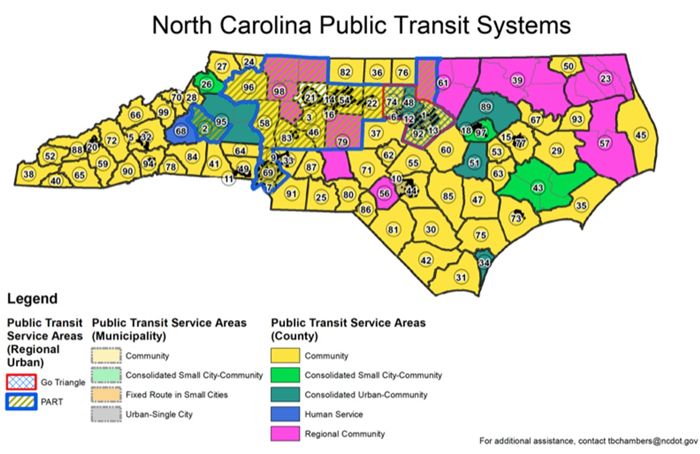
All 100 counties in North Carolina have some form of public transit systems. The structure and services of these systems vary widely from daily bus routes to only on-demand services for the elderly and indigent. They are funded by multiple federal departments and agencies and not just the U.S. Department of Transportation. Because of the extreme gap in the population density between urban and rural areas, both the demand and the services require different solutions. The NC Department of Transportation Rail Division operates trains to supplement Amtrak between Raleigh and Charlotte as well as maintain the rights-of-way on that route that is owned by the state.
Raleigh’s approach has been to prioritize denser development within the I-440 corridor to create the demand for more public transit rather than to develop new corridors. Charlotte took an approach of “if you build it, they will come” with their light-rail program. The I-540 corridor in Wake County is still under development and isn’t projected to complete construction for several years. The build-out is being funded as a toll road. As a result, multiple communities along this proposed route have experienced explosive growth in recent years. New bypass routes for US 70 and US 64 have relieved some of the congestion on I-40, but the southeast corridor is still clogged with new construction. Rebuilding the western section of I-440 will take a couple of more years.
The metropolitan planning organizations for the two federal statistical areas in the Triangle anticipate continued rapid growth for at least two decades. (I can’t explain why there are two.) We will continue to try to catch up for failing to meet our needs as the area grew and will remain behind the 8-ball in providing adequate public transit.
 This email address is being protected from spambots. You need JavaScript enabled to view it.