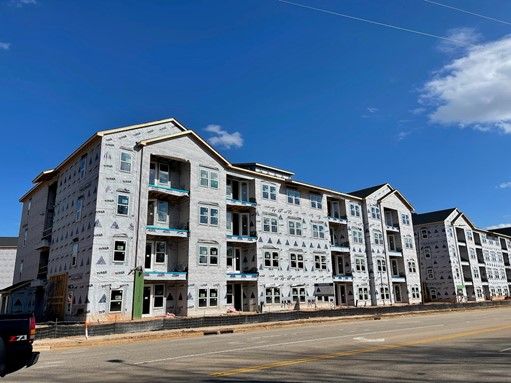
 Apartment Buildings Under Construction in Raleigh © John Suddath
After a hiatus of more than a year, I recently drove over to Durham. I saw new rows of mid-rise apartments along NC 147. They looked just like the ones that have populated the Triangle in the past decade. Developers used the cheap money of low interest rates on construction loans and cheap construction materials and methods to maximum their profits. In spite of those low costs, they claim they can’t “make the numbers work” to build affordable housing.
Sure, they are priced now as luxury apartments even though most are small and cheaply furnished. The cookie-cutter designs also save on cost, but they show a lack of imagination or architectural integrity. In the 1950’s and 60’s, the Triangle was a hot bed of innovative design. Now we have become an architectural desert, both for commercial and residential buildings. Housing subdivisions offer color choices, decorative tack-ons, and a variety of floor plans and size. They mostly are conservative look-alikes that offend none but offer little real choice unless you chose a custom-built home.
We have the Hunt Library, the Talley Student Center at NCSU, and the Cathedral of the Holy Name of Jesus as notable exceptions. But we have miles of hum-drum monotony along our major thoroughfares. Good design does not have to be that much more expensive; it simply needs to be considerate of the milieu in which it is built. If you sit through the hearings of the Raleigh Appearance Commission, the boring droning on about every detail will put you to sleep. The apparent intent is to maintain conformity rather than encourage innovation. Yes, it’s better to hide parking garages, have setbacks, and to consider storm water run-off. They follow the planning department’s guidelines to encourage greater density to support public transportation, rather than vice versa.
I realize this is a broad indictment and there are many excellent architectural firms in the Triangle, but much of the design work is from mega corporations outside the area that simply are trying to cash in on the boom as cheaply as possible without any consideration of the consequences. A little plaza every now and then is nice, but what about the canyons of glass towers?
Cities in the Triangle have a relatively short history so there’s not a lot to preserve. But when we look the City Halls in Durham and Raleigh and the Halifax Mall that date from the 80’s, we might wish that we could have skipped a generation. Do we really need another sports arena subsidized by taxpayers? Do we want public buildings with character?
Midtown is a small city that reflects the glass towers of the past 20 years mixed with the assembly line apartment complexes. It sits solely dependent upon the already clogged I-440 for access. How can you get downtown or to the airport? Obviously, the “mixed-use” concept promoted the idea that you never need to go downtown anymore. But what if you want to go a concert at the Duke Energy Center or the PNC Arena for a ballgame? We have been talking about public transportation for 25 years but have done very little about it.
The Triangle is not unique with its suburban sprawl and focus solely on the automobile as the only mode of transportation. The search for cheaper land prices farther out does not necessarily drive the best choices of public policy planning. When I moved here 25 years ago, Brier Creek was a cow pasture. With the construction of I-540, it became a small city. We’re promised commuter rail this decade. We’ll see. We’ve been misled before.
 This email address is being protected from spambots. You need JavaScript enabled to view it.