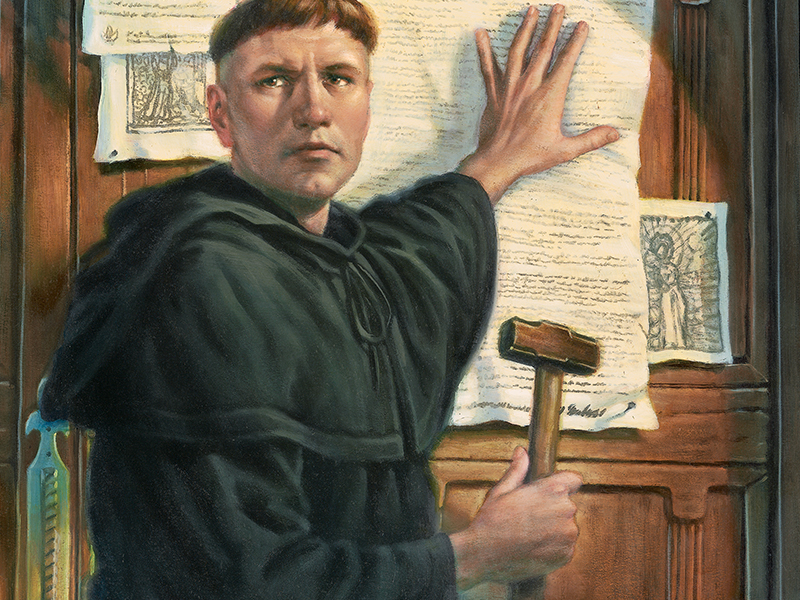
Outraged by the selling of indulgences, the German monk Martin Luther posted 95 Theses on the door of the Catholic Church in Wittenburg in 1517. At that time, the process was a form of debate and public communication. After hearings and trials five years later, he was excommunicated by the Pope. Because of the controversy, he was forced to go into hiding. He took that opportunity to translate the Bible into German. He also published other volumes, which with the invention of the printing press, spread quickly across Europe. In his later years, he became increasingly bitter and anti-semitic. He assumed a very narrow view that the Jews, rather than the Romans, killed Jesus.
The Lutheran Church was the beginning of Protestantism, which was a formal breach with Catholic Church. As another sign of that breach, Luther married a former nun, had six children, and served in a parish. The Augsburg Confession (1530): This remains the primary document for Lutherans. It was presented to Emperor Charles V by German princes to explain their faith and seek peace. Lutheranism became the official state church of many German territories and Scandinavian countries.
Until that time, the only split had been the Roman Catholic Church in Rome and the Orthodox Church in Constantinople in the 11th Century. The Protestant movement included John Calvin in Geneva and John Knox in Scotland. In 1534, King Henry VIII of England broke with Rome and formed the Anglican Church. In 1525 William Tyndale published a partial translation of the Bible into English. The first translations from the Latin Vulgate into Middle English was from 1382 to 1395. They were published by John Wycliffe and a group of scholars at Oxford. Over a period of two hundred years, hundreds of Protestant Denominations spread across the world, and the Bible had many other translations even to this day. Some churches were only splinter groups, and others included a large number of congregations.
Because of the growing religious rift, in 1618 Europe was thrust into 30 years of Religious Wars. Because the Protestants believed that everyone should be able to read the Bible, the movement led to an increase in literacy. The Reformation weakened the power of the Papacy and paved the way for the modern nation-state, as monarchs took control over their religious affairs. Thus, it became a political movement as well as a theological movement.
The Protestant Reformation involved a large number of scholars as well as secular leaders, but it was Martin Luther to whom most of the honor has been given. In all credit, the printing press provided opportunities for reaching a much wider audience than previously possible.
 This email address is being protected from spambots. You need JavaScript enabled to view it.