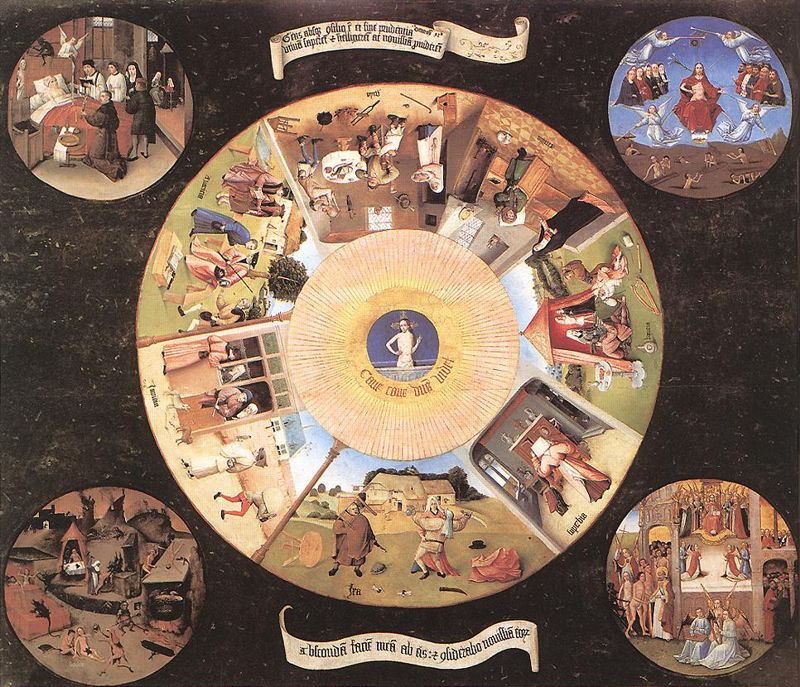
 The Seven Deadly Sins by Hieronymus Bosch
The seven deadly sins of: pride, greed, wrath, envy, lust, gluttony, and sloth, are contrasted with the four cardinal virtues of: prudence, justice, temperance, and fortitude and the three theological virtues of faith, hope, and charity. These characteristics seem somewhat archaic in today’s society. Let’s start with truth and honesty. Lies and disinformation.
For generations, when people spoke of public morals, that was code for strict limits on sexual behavior. From the beginning, the church had a problem of dealing with sex. The Roman Catholic Church survived for more than a thousand years before deciding that priests had to be celibate. Celibacy, abstinence, and chastity are not the same. Celibacy is a voluntary choice not to marry. Abstinence is a temporary avoidance of sex. Chastity is more than abstaining from sexual activity.
In a broader sense, the culture or social mores, define what is acceptable or not within a particular society. We supposedly are in the midst of “the culture wars,” which generally refers to a person’s attitudes or beliefs about homosexuality or gender identity.
But I think of morality in a broader context of social responsibility and social justice. The lack of opportunity, inequality of wealth, discrimination against minorities, and disregard for others are basic to me. If we are totally self-absorbed and self-indulgent, to me, that is a moral failure. Jesus taught that we are to be servants in mission to the needs of others. We will be judged by what contributions we have made to society, not just in terms of financial resources. Perhaps our most valuable resource is our time, which, by definition, is limited in this world.
This seems to originate in a mindset: scarcity or abundance. If we believe that we have to protect what little we have, even if it means cheating, is a worldview of “dog-eat-dog” or survival of fittest. If we believe in the abundant life, then we aren’t so scared and are more willing to share. An analogy is often made about the scarcity of food world-wide, when it is really an issue of distribution, geography, and local resources. The response is to teach people how to produce food efficiently rather than being dependent on the dole. Of course, in this country few of us really grow any food, nor is it reasonable to expect us to do so. We get our food in exchange for payment to those who grow and distribute it. We have an efficient system except for those who are unable to pay.
Most of us grow up with at least some sense of right and wrong. One definition of the pathological is the inability to know the difference. Of course, those values differ depending upon our cultures and background.
Americans seem to be obsessed with sex. That can only be partially blamed on advertising. It is also a reaction to the Puritan restrictions and hypocrisy of the Victorian era of the 19th Century. We experienced a so-called “sexual revolution” in the 1960’s with free love that just seemed more like teenage rebellion.
As one judge was reported to have said about pornography, “I know it when I see it.” I know a moral person when I see one. It is a person who lives a “good life.”
 This email address is being protected from spambots. You need JavaScript enabled to view it.