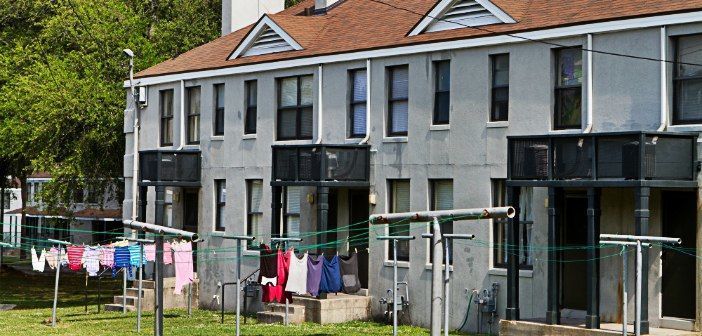
This topic is one of the most commonly discussed issues in town halls and public meetings with little impact on increasing the supply. The fact that we have 1.1 million public housing units managed by 3,000 housing authorities has not provided the number of low-income housing units that are needed. The nation is still in short supply of more than 4.5 million homes. The US Department of Housing and Urban Development (HUD) and the Agriculture Department’s Rural Development Program have nine initiatives designed to address affordable housing needs. The Funding simply has not kept up with demand for decades.
In addition to the obvious factors of low supply and high demand, the increasing cost of production has also been accompanied by minimal increases in wages at the lower level.
Too many people live below the poverty level because the minimal federal wage of $7.25 has not increased in 20 years! While wages in finance and technology have surged in that time, service and working-class employees have not seen significant increases.
Many manufacturing jobs have been sent offshore, and other jobs require a minimum of a college degree. The cost of higher education has ruled that out for most working people regardless of federal and local grants.
In 2025, 75% of U.S. households cannot afford a median-priced home of $300,000. Home prices have increased 60% nationwide since 2019. Rising land prices, construction costs, and increasing interest rates make single-family homes unaffordable. Multiple-family housing also is not affordable for many people because of high rents. Most construction new condos and apartments has gone to high-level housing, which is more profitable for developers. Vouches are now widely used to supplement rent to make it more affordable, but they have waiting lists of years.
Real estate markets have been a highly-variable-industry with years of boom and bust. The recession of 2008 required a long recovery, and we’re still trying to catch up with the growing population. In North Carolina, in the urban areas we have seen a booming economy and a booming housing market that still can’t keep up with demand.
In the U.S. following WWII, we mass produced cheap single-family homes in the suburbs for the first time to meet the demand. European cities abandoned single family housing generations ago for high-story apartment buildings they call flats. Sometimes the individual units are owned outright, but most of rentals. New York tried to deal with the problem during WWII with rent control units. Some of these have continued and are only available only on the death of the tenant. Property owners are gradually closing these out.
When a small percentage of the US population can afford multiple houses both in the US and abroad, most people cannot afford even decent rentals. This chasm demonstrates the economic inequality of the population in this country. It is only getting worse. Thus, “affordable” depends upon with whom you are having the conversation. It is popular now because most people cannot afford decent housing at a reasonable price as we become more urbanized. We have the means to solve this problem of affordable housing; we just lack the political will to do it.
 This email address is being protected from spambots. You need JavaScript enabled to view it.