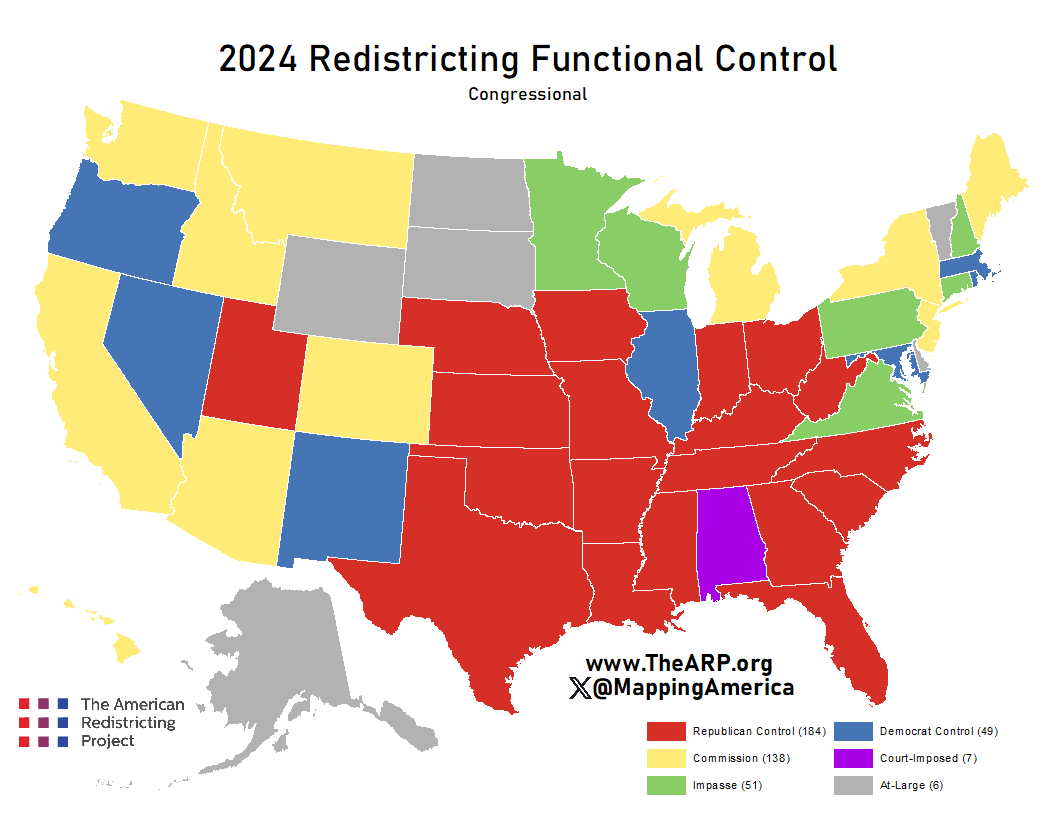
The U.S. Constitution specifies that Federal Congressional Elections for the President will be held every four years, senators every six years (the schedule varies), and two years for the representatives. Each state sets its own election laws and appoints an election board to conduct the elections, publicize the rules, and announce the winners.
In addition, the Census Bureau conducts a census of every voter every ten years. The maps that divide the federal districts are redrawn every decade to reflect the changes in population density, movement of voters, so that the election will be current.
For decades, the maps had been unfairly drawn to favor one political party. In 1964, cases before the Supreme Court established the rule of one person, one vote. The Voting Rights Act of 1965 prohibited drawing maps where one district increased racial gerrymandering. Many of the conditions of that Act have been stripped out.
In 2000, the combination of powerful computers, mapping software, down to the individual house created a more complicated system. In 2019, The U.S. Supreme Court ruled that gerrymandering maps were unacceptable. In recent years, California and Texas have gone all out to rig their congressional maps to support their own primary political party. The effects of those local partisan trends is a national trend again to increase polarization in voting and to reduce political competition.
As result, a dozen states have an independent, non-partisan commission to draw the maps rather than have the state legislators to draw the maps. A surprising event occurred when the Indiana State Senate rejected a map that they said violated the state constitution.
Whatever way or detail the state laws are written, people are going to try to rig the elections in their favor. Of course, the way a person voted in the last election is only a general guide how they may vote next time. There are too many variables in play to accurately predict their vote. Millions of dollars are spent each year to try to influence voters with advertising, public events, and attacks on the opponents. Vicious name calling goes all the way back to the first elections, including attacks on George Washington. Of course, there have been many complaints about how elections were rigged, if they were issued by the losers.
 This email address is being protected from spambots. You need JavaScript enabled to view it.