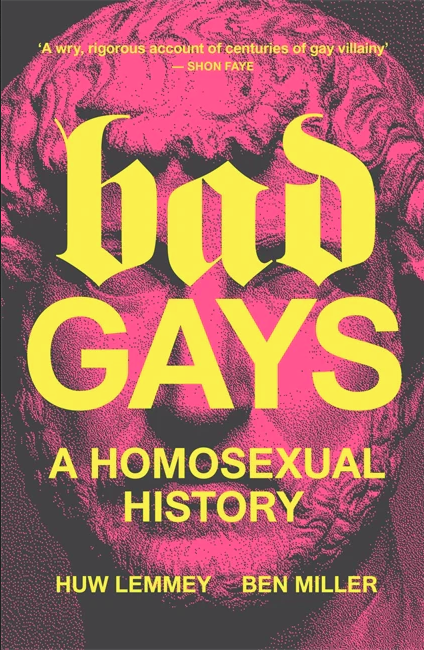
Bad Gays: A Homosexual History by Lemley and Miller
a review by John Suddath
From the preface of the book: “Homosexuals are … widely consigned to the same category of things as drugs, the category of illicit dirty things that people have to be protected from … since the homosexual is continually taught by the world around him that his natural home is the sewer, the homosexual is uniquely equipped to discover what truly belongs and doesn’t belong in the sewer.”
This English book traces the history of 15 infamous gays starting with Hadrian, the Roman Emperor. The author summarized the theme of the book as: By examining the interplay of their lives and their sexualities, this book investigates the failure of homosexuality as an identity and a political project. Which is an explanation of the title: Bad Gays.
Each chapter provides a summary history of the period, so it is not just the sexual proclivities of each person. It reads like a bitchy gossip column, particularly where the facts are not clearly established. I’m never sure whether they are lamenting the repression and discrimination of the times, or if they just think these people are evil. They frequently repeat the comment that the concept of “homosexual” did not evolve until the 19th Century. Thus, it is difficult to give a historical account of all the forms of the LGBT community including gender identity, sexual preference, gender expression, etc.
“A principle of understanding our status as gay people both within our culture and within wider society is this: we are not just the protagonists, but also the products of history.... If our history of homosexuality has any consistent lesson, it’s that the ability to live as queer people faces challenges that are always fluctuating.... Throughout the 1970s and 1980s, gay liberation continued to exist in meaningful, if complex, alliance with anti-colonial struggles in the imperial core.... In the aftermath of AIDS, as movements in Britain and the United States began to be more and more dominated by a class of people who had never before been so involved in gay and lesbian organizing.... We do not get to choose who we are, but we do get to choose how, and with whom, we dance.”
This is the most succinct summary of the authors’ view of gay history. Their rambling, one-sentence paragraphs sometimes can make for difficult reading.
To paraphrase their conclusion, the modern view of LGBTQ people is that we all are family. Because we were not born into blood kin, we get to choose ours. The internal division among the LGBTQ community also was a handicap in creating some sense of identity. We not only were rejected by society, we were at odds among ourselves. They are committed pessimists, and they still see the world as homophobic. They don’t address the major accomplishment that same-sex couples legally now can be married and raise children. This was an idea beyond comprehension 50 years ago. The LGBQ community is still evolving socially and politically, and so is the world around it.
 This email address is being protected from spambots. You need JavaScript enabled to view it.