
Season’s Greetings
This is an ambiguous title that covers all religions and belief systems and celebrations of the winter solstice. Some use the greeting “Happy Holidays,” and other refer to specific religious holidays. I never can get the spelling for Chanukah correct for Judaism, Kwanzaa for African traditions, and the Persian festival Yaldā. In the East, they celebrate the Dongzhi Festival. Of course, Christians celebrate Christmas.
When you consider the holidays, you also have Santa Claus, the Yule tree (or log), Snow Men (why no women?), and a wide range of holiday songs that address everything but Christmas. The spirit of giving has been commercialized and starts in October. We almost ignore Thanksgiving, which is celebrated only in a few countries. Epiphany is an afterthought.

Gratitude is More Than Just Saying Thanks
Thanksgiving is known primarily as a gathering of extended family around a feast. It is a family holiday more than a celebration of an event. It prompted me to more carefully consider the benefits of gratitude:
- Gratitude turns what little you have into abundance.
- Gratitude is so much more than saying thank you.
- Gratitude changes your perspective of your world.
Gratitude is both a state of being and a personality trait. For too much of my life I did not feel or show gratitude, and that led to a feeling of negativity, resentment, and anger.
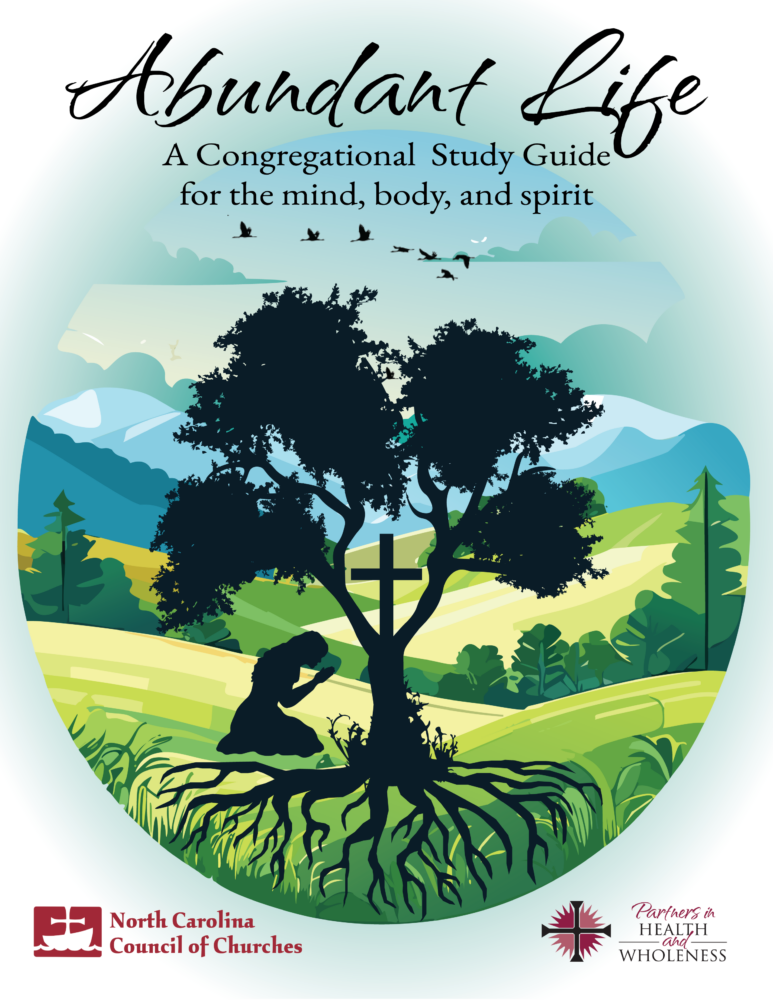
I would like to recommend a 4-part congregational study guide that has been prepared for the North Carolina Council of Churches by Partners in Health and Wholeness. With the recent natural disasters in North Carolina, as well as around the world, we should consider those who are less fortunate. Their circumstances may impact their mental health. Then we have the tension and anxiety just before election day.
The 37-page guide is entitled Abundant Life in Mind, Body, and Spirit and is available to download from the Council’s website. Each session includes a reflection on scripture, discussion, a frame of reference for the group process, and case studies. The course provides resources of where to direct our congregations for more long-term help.
The assumption of HEALTH: physical, mental and social well-being and not merely the absence of disease or infirmity.