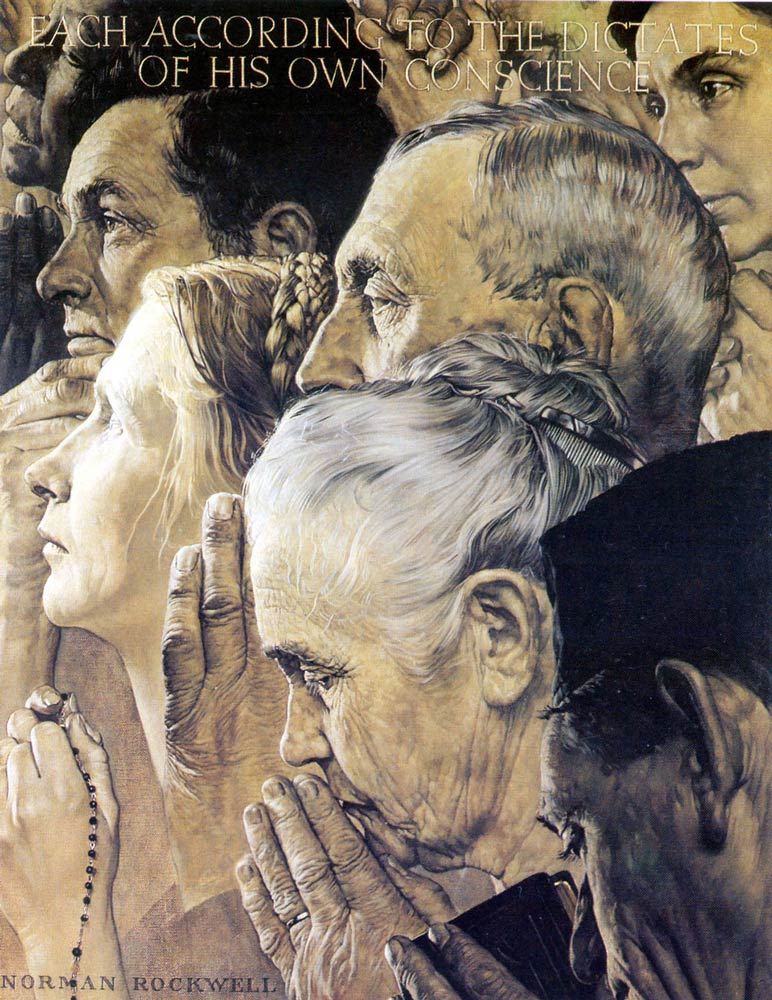
 Norman Rockwell's Freedom of Worship
Too much conversation has focused on the right to refuse to bake a cake, to photograph, or to prepare a floral arrangement for a wedding. The only relevant discussion about weddings has been the decision of the U.S. Supreme Court to allow same-sex weddings. Does withholding of services constitute discrimination? Some courts have said Yes.
The claim that religious beliefs allow people or religious institutions to discriminate is a specious argument. The First Amendment to the Constitution claims a separation of church and state and says that government cannot impose any restriction upon the practice of religion. That is, you can belong to any religious organization or church you like. Within that organization you cannot be exempt from the law. For example, some religions practice polygamy. In the United States that is illegal.

Fundamentalism is a branch of organized religion that is difficult to define. In my understanding, it promotes the Bible as the sole authoritative source of Christian theology. It usually refers only to the King James translation of the scriptures. There are also some fundamentalist versions of Islam.
In contemporary terms, it more often refers to culturally (and politically) conservative attitudes, opinions, and beliefs. It emphasizes tradition. In my mind, it refers to the radical right in both cases. WASP (White, Anglo-Saxon, Protestant) isn’t extreme enough. In the age of the Great Awakening around the turn of the 20th Century, the traditional doctrines focused on literal interpretations of the Bible in their theology. But those were simpler times, and the United States was not as culturally or racially diverse as it is now. Yes, we had ethnic and racial minorities from the beginning, but we were primarily Christian in some form or other. The Protestant denominations were more homogeneous within their groups even though they were sharply divided among each other.
 Erecting the Wall of Separation Between Church and State is Absolutely Essential in a Free Society ~ Thomas Jefferson
The issue was addressed in the First Amendment to the U.S. Constitution but never clearly defined. It has been debated ever since then. Thomas Jefferson had the opinion that it was as much a freedom from religion (domination) as of religion. At that time, most countries in Europe had an official religion of the state. An individual must either belong to the state church or be declared a dissenter. Those churches received funds from the taxes imposed by the state, while they also were exempt from paying taxes. We still say that most churches are exempt from taxation. They may be taxed if some aspect of that church involves a business interest.